
Ludoya Premium
Pick the plan that fits your play
Premium features for players. Powerful tools for organizers. Professional-grade operations for venues.
Ludoya itself stays free, with no limits — the first column is not a trial. These plans add the extras.

Free
Everything you already have, in full
No credit card needed
- Unlimited play logging
- Live sessions and timers
- Your whole collection
- BoardGameGeek and BGA sync
- Events, RSVPs and waitlists
- Groups and clubs
- Forms, up to five questions
- Messages and club inbox
- Marketplace, buy and sell
- Stats, badges and Replay
- AI assistant, ten questions a month

Player
For hobbyists who love board games
billed €21/year
- Everything in Free
- AI Board Game Assistant
- Shelf Planner
- Campaigns
- Recurring events
- Automatic Cancellation
- Game Lending Tracker
- Boosted Marketplace Listings
- Submit Game Changes
- Premium Profile Badge
- Increased Visibility

Club
For organizations running regular meetups
billed €84/year
- Everything in Player
- Telegram and Discord
- Tournaments
- Club insights
- Raffles
- Event Sub-Events
- Festival Team
- Unlimited Form Questions
- Public API
- Shared inbox and audit log
- Membership tiers
- Game Library Lending

Business
For stores, cafés, clubs and conventions
billed €498/yearbilled €210/year
- Everything in Club
- Ludoya Tickets
- Every location on your profile
- QR Entry Verification
- Interactive Venue Floor Plans
- Table Bookings
- Event on the Big Screen
- Quiz Trail
- Event Game Library
- Second-Hand Market at Your Events
- Auto open/close
- Raised API Limits
14-day free trial on any plan you haven't had before · Cancel anytime · Secure payment via Stripe
Everything in Player
Features for every board gamer

AI Board Game Assistant
Never pause the fun to dig through rulebooks again. Pick a game, ask a question, and get an instant answer. You can even attach a photo of your board state or a rulebook page for context. Works for thousands of games, with a free daily quota and expanded limits for premium members.
Shelf Planner
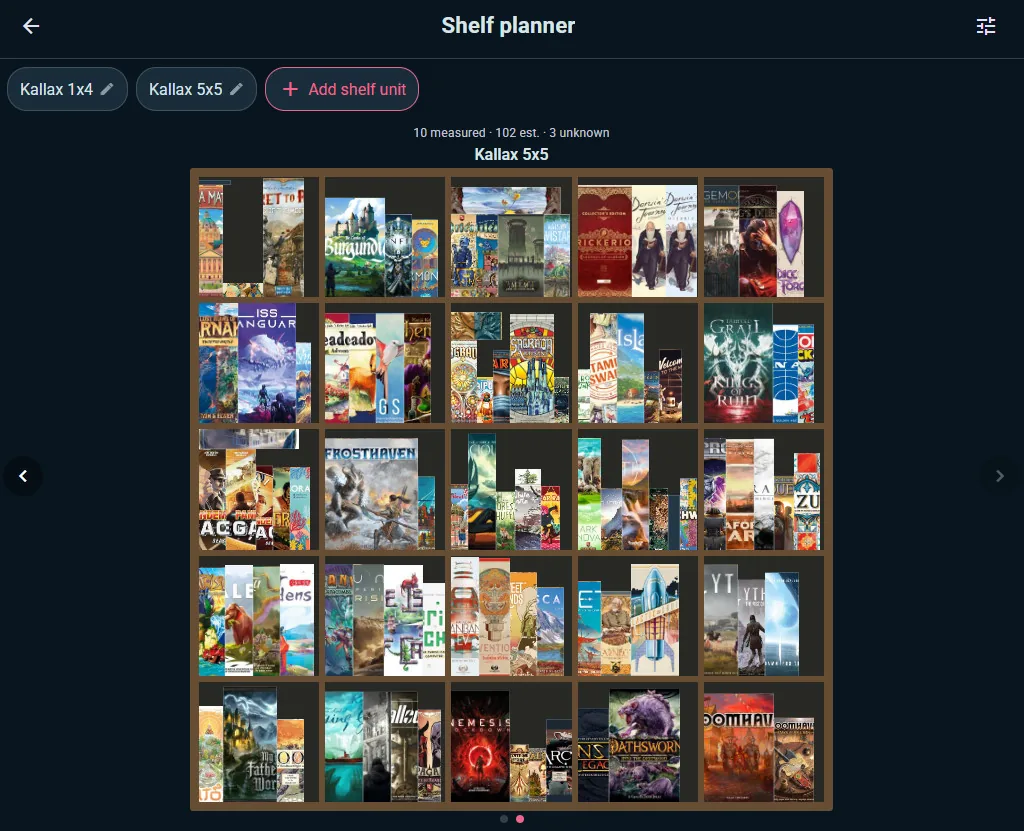
Tell Ludoya about your furniture and it packs your collection into it in 3D, using the real box dimensions of every game — so you know before buying your next shelf whether everything fits. Explore the result in an interactive 3D view, see exactly where each game should go, and get suggestions for the furniture units that would hold your whole collection. No shelves yet? A wizard walks you through setting them up.

Campaigns
Keep your long-running adventures organized in one place. Create campaigns linked to a game and optionally a group, invite members, and define characters with backstories and custom attributes. Track world state using typed fields — text, numbers, selections, colors, and images — and use game kits as starting templates. Log each session and build a living record of your group's story over time.

Recurring events
Set up your recurring session once and let Ludoya handle the rest. Choose a day of the week, set your repeat interval — weekly, biweekly, or any custom cadence — and new events are created automatically on schedule. Add an optional end date or let it run indefinitely.
Automatic Cancellation
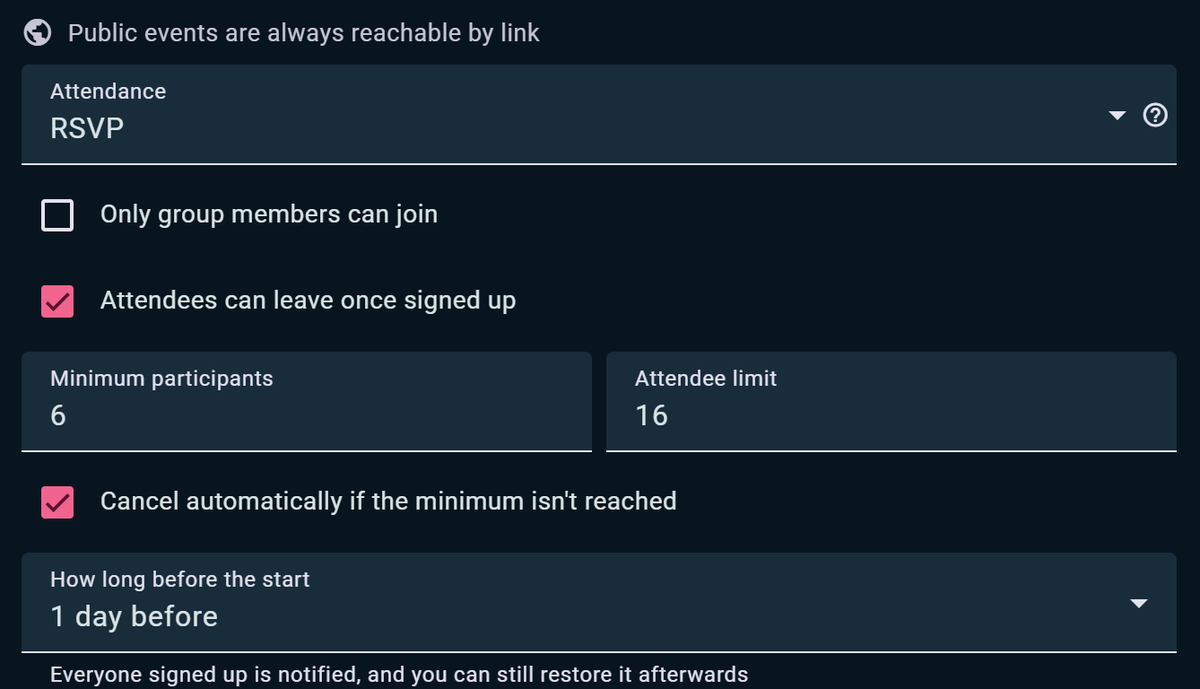
Set a minimum number of players and choose how long before the start the event should give up on reaching it. Ludoya counts the sign-ups for you: if the table is still short at that point, it cancels the event and tells everyone who had signed up, so nobody travels to a game that was never going to run. You get a heads-up first, while there is still time to recruit — and if someone turns up at the last minute you can restore the event, which switches the timer off for good.

Game Lending Tracker
Never lose track of a borrowed game again. Log which games you've lent out, link the borrower to their Ludoya profile, and set an expected return date. When they bring it back, record the return with optional condition notes. The Loans tab shows every game you have out on one screen, the late ones first, with the history of each copy and of each borrower.

Boosted Marketplace Listings
Give your sell and trade listings a permanent edge. As a premium member, your items rank higher in search results and browse pages — and unlike regular listings, they never expire as long as your subscription is active.

Submit Game Changes
Help keep Ludoya's game database accurate and growing. Add games that are missing from the catalog, or propose corrections to existing entries — names, player counts, age ratings, play times, images, and creator credits. Each submission includes your explanation and goes through moderation review, keeping the data reliable for the whole community.

Premium Profile Badge
Let everyone know you support Ludoya. A premium badge appears next to your name across the platform — on your profile, in event attendance lists, and wherever your name shows up. A small mark of distinction that signals you're a dedicated member of the community.

Increased Visibility
Stand out in the community. Your events, reviews, and content receive priority placement in the social feed, helping you reach more players and grow your gaming community.
Everything in Club
Tools for organizers running regular meetups

Telegram and Discord
Connect your organization to Telegram in three steps: add @ludoyabot to your Telegram group, generate a link code in Ludoya, and type /link followed by the code in your chat. From then on, new events are announced automatically — no copy-pasting, no manual updates. On Discord, link a channel of your server the same way: the Ludoya bot announces your events there, keeps every announcement up to date and lets members take a seat from it. Your community stays informed in the app they already use.

Tournaments
Create a tournament-type event and choose Swiss, mixer, or single/double-elimination — Ludoya generates each round's pairings, keeps live standings with tiebreakers, and draws the bracket as matches resolve. Every match becomes a scheduled game your players report, and byes advance automatically. Perfect for game stores, conventions, and competitive gaming groups.
Club insights
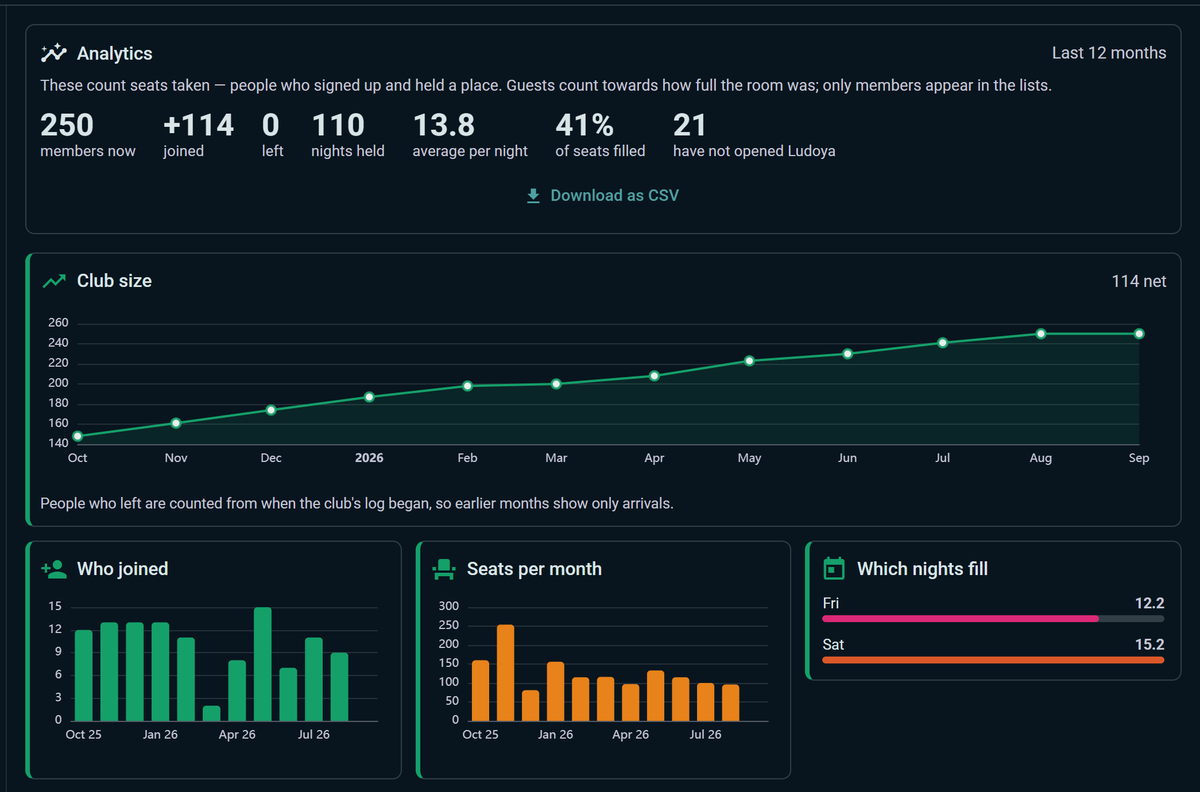
Your club’s own attendance, read back as decisions. Regulars who have gone quiet — measured against each person’s own rhythm, so a monthly club is not judged like a weekly one — and the newcomers who came once and never returned. Which weekday, hour and game actually fill seats, and how new and returning faces have moved month by month. What your members have said they want to play, most wanted first, next to whether the club already owns it. And inside a single night, a density heatmap of when your attendees are free, in 15-minute segments, so the big game starts when the room is fullest. Admin-only, built from the sign-ups you already have: no extra forms, no surveys, nothing asked of your members. Export any of it as CSV.
Raffles
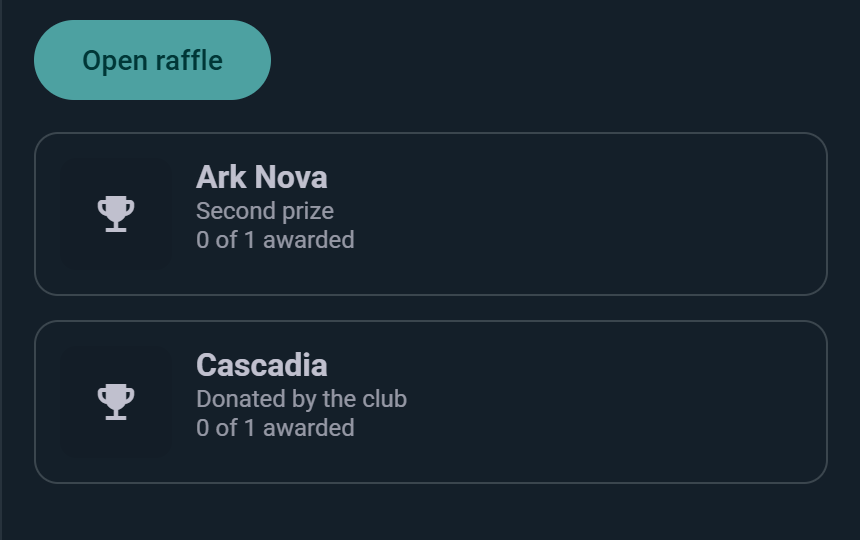
Reward your attendees with prize raffles. Create a raffle on any event, add your prizes, and run a live animated draw that everyone can watch as the winners are revealed. Perfect for game-store giveaways, convention prize tables, and community appreciation nights.

Event Sub-Events
Organize complex gatherings with ease. Create sub-events inside your main event — perfect for running parallel tables, tournament rounds, or themed sessions within a single event.
Festival Team
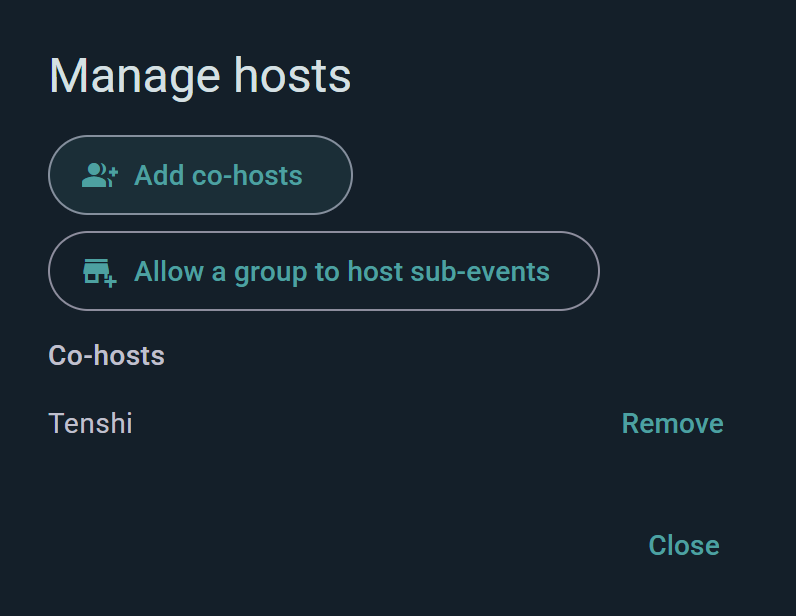
Run a festival as a team. Let publishers and clubs host stands of their own inside your event, keep each volunteer to the tables, stands or entrance they look after, and hand the whole crew one link or QR code to ask to join. Co-organizing an event with another club stays free.
Unlimited Form Questions
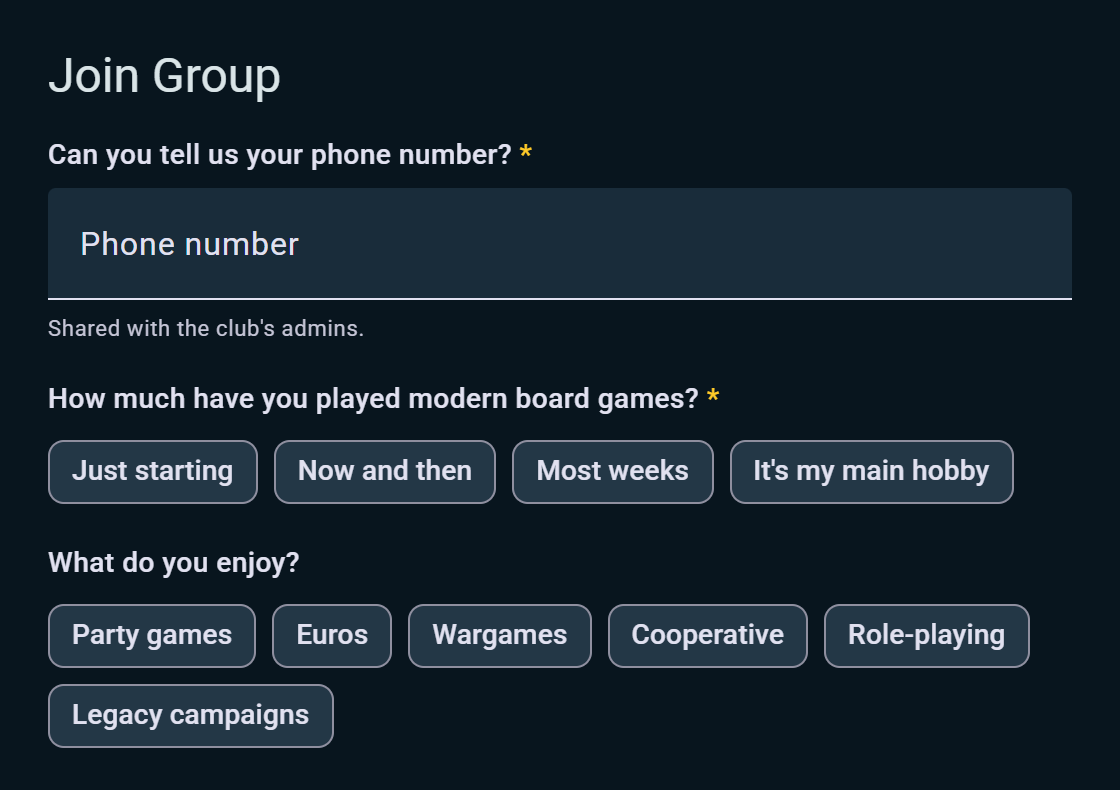
Custom registration forms are free on every plan, up to five questions per form or template. Club lifts the cap: ask about allergies, experience, seating, transport, consent and anything else you need to run the night, with every answer linked to the attendee and exported alongside the list.
Public API
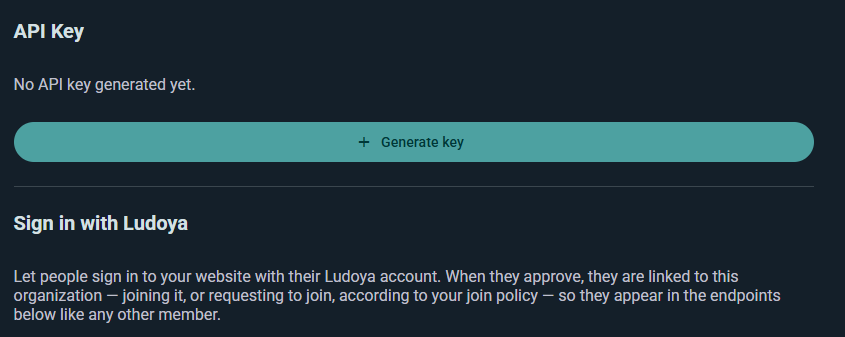
Expose your organization's data through a simple REST API. Generate an API key from your organization's console, under Integrations, and start pulling live data — upcoming and past events, your member list, your game collection, and play statistics — into your own website, app, or automation. Authenticate with a single header, and your key can be revoked and regenerated at any time. Runs on WordPress? A free plugin puts your events on your site without writing a line of code. Club keys allow 30 requests a minute and 2,000 a day; Business keys are raised to 100 a minute with no daily cap.
Shared inbox and audit log
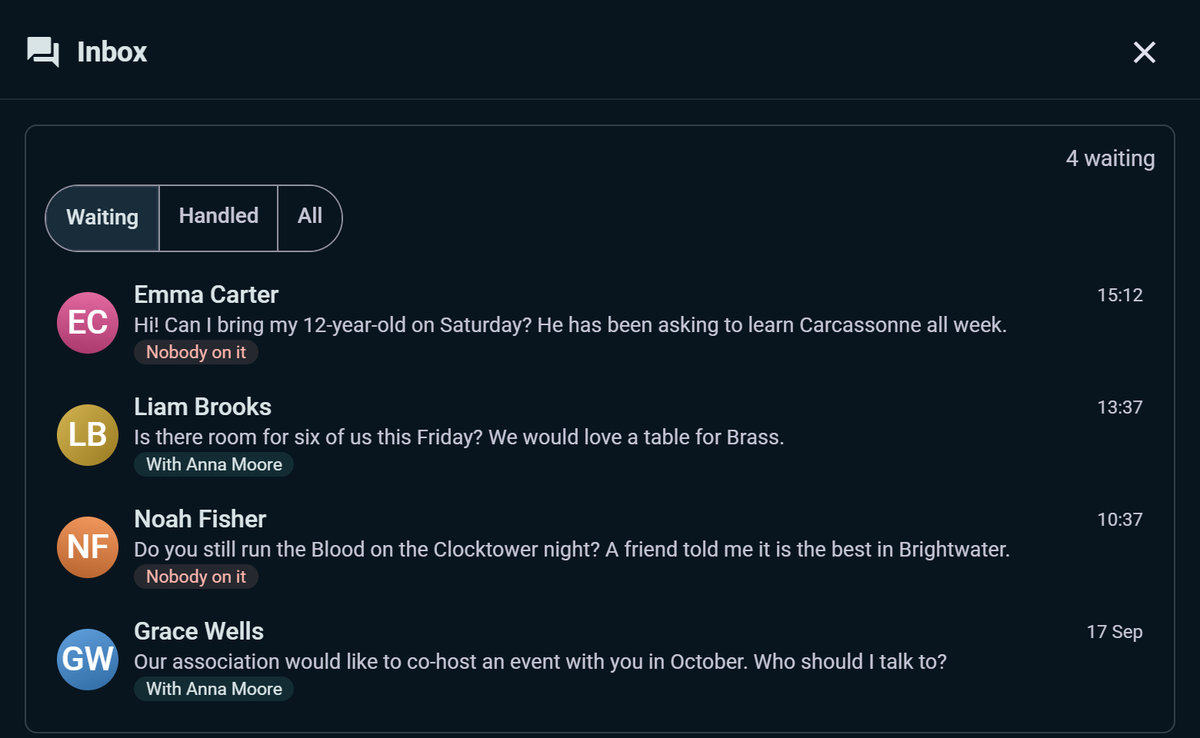
Reading the club's messages, answering them and marking them handled is free on any plan. This is what makes that work with more than one admin: hand each conversation to one admin so nobody answers it twice, and see at a glance who is dealing with what. Beside it, the audit log records every change an admin made to the club — roles, removals, settings, tiers, events — with who did it and when. Nothing here can be edited or deleted, which is what makes it worth reading when somebody asks "who removed Marta?".
Membership tiers
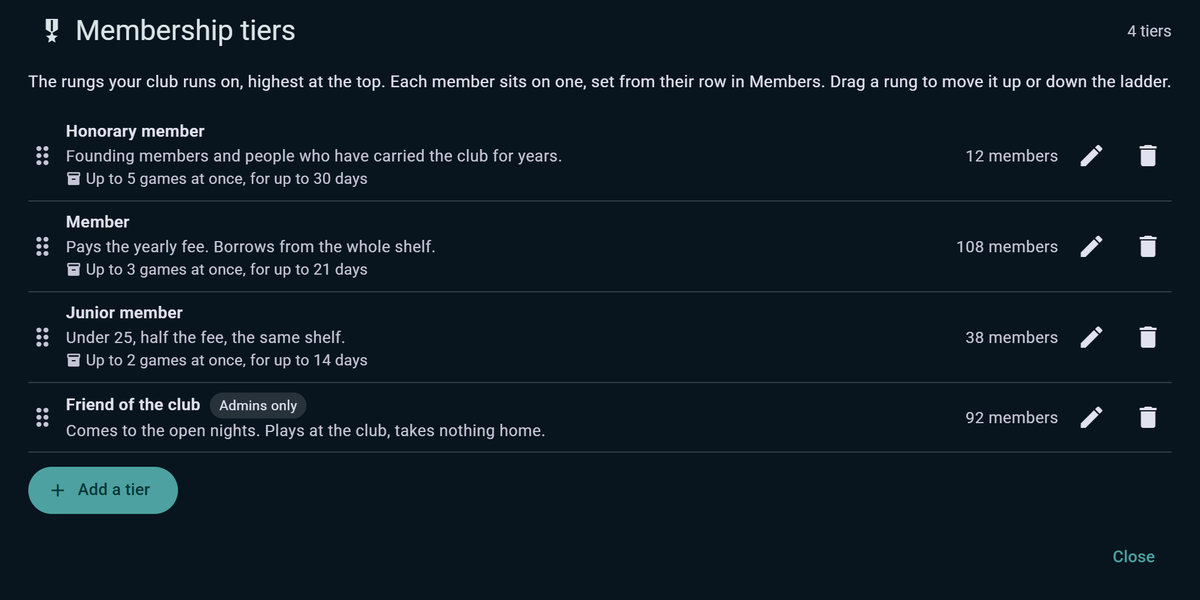
A ladder of memberships — supporter, member, patron, whatever your association calls them — with each rung's own rules. Keep a copy for a rung and above, so the expensive game stays on the shelf for the people whose dues paid for it. Give each rung its own limits: how many games a member may hold at once, and how long they may keep them. Members see the rung they are on, and the library refuses politely and says why. Dues come with it: record them by hand when a member pays in cash, or let members pay each period by card, into the club's own Stripe account. And give the club, and each tier, a badge of its own that members wear on their profile, so anyone can tell a member or a patron at a glance.
Game Library Lending
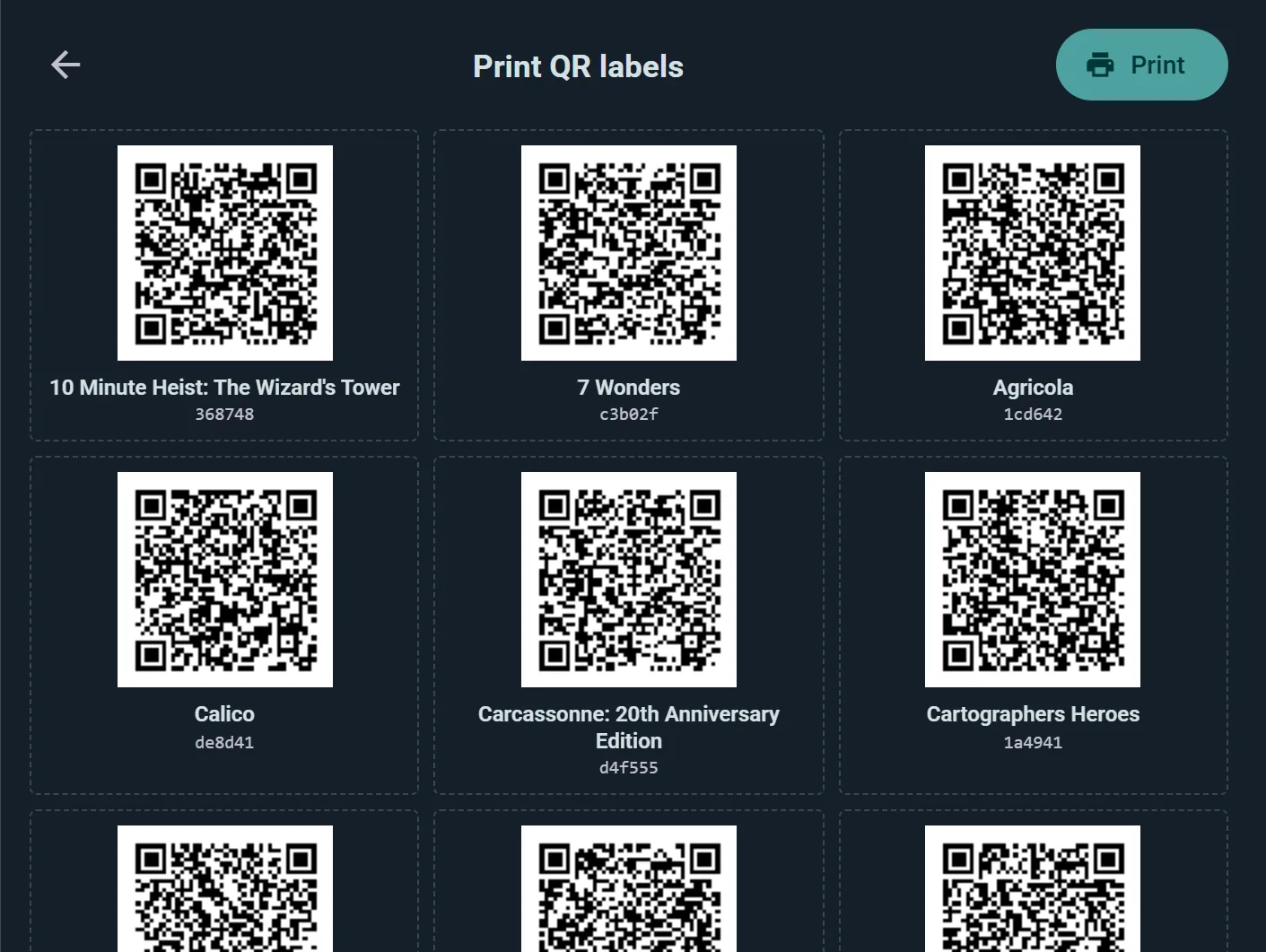
Give every copy in your library its own QR label, printed straight from Ludoya on a standard A4 sheet. Anyone who scans a label sees the game, who owns it, and whether it's available right now. Members borrow and return self-service, and reserve a game that is out: the copy that comes back waits for them. During your events attendees take and return games right at the table. Every loan is tracked, and your membership tiers decide who may take what. Staff can also scan copies in bulk to set inventory locations, register games to an event, or mass-return a pile at closing time.
Everything in Business
On-site operations for venues running events at the door
Ludoya Tickets
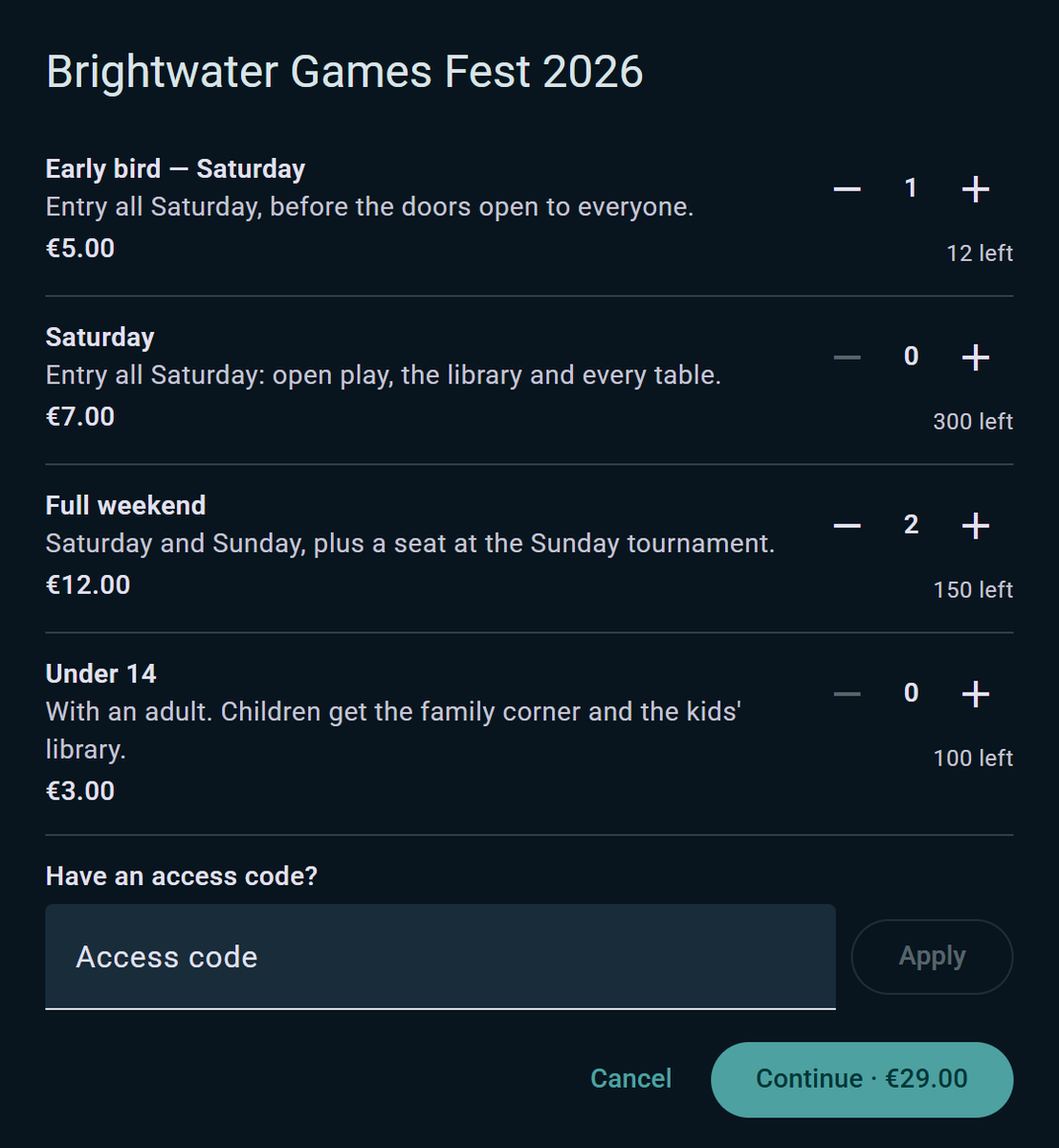
Sell tickets entirely inside Ludoya — no external platform and no redirect for the buyer. Define ticket types with their own price, quantity, and visibility, and attendees buy them through an embedded Stripe checkout right on the event page, one tap, for themselves or a whole group. You connect your own Stripe account and are the merchant of record, so buyers pay you directly and payouts land in your account; Ludoya takes a flat 3% per sale. Each ticket gets its own QR code for check-in at the door, buyers keep every ticket in an in-app wallet, and you track sales and issue refunds from the event's sales panel without ever opening Stripe.
Every location on your profile
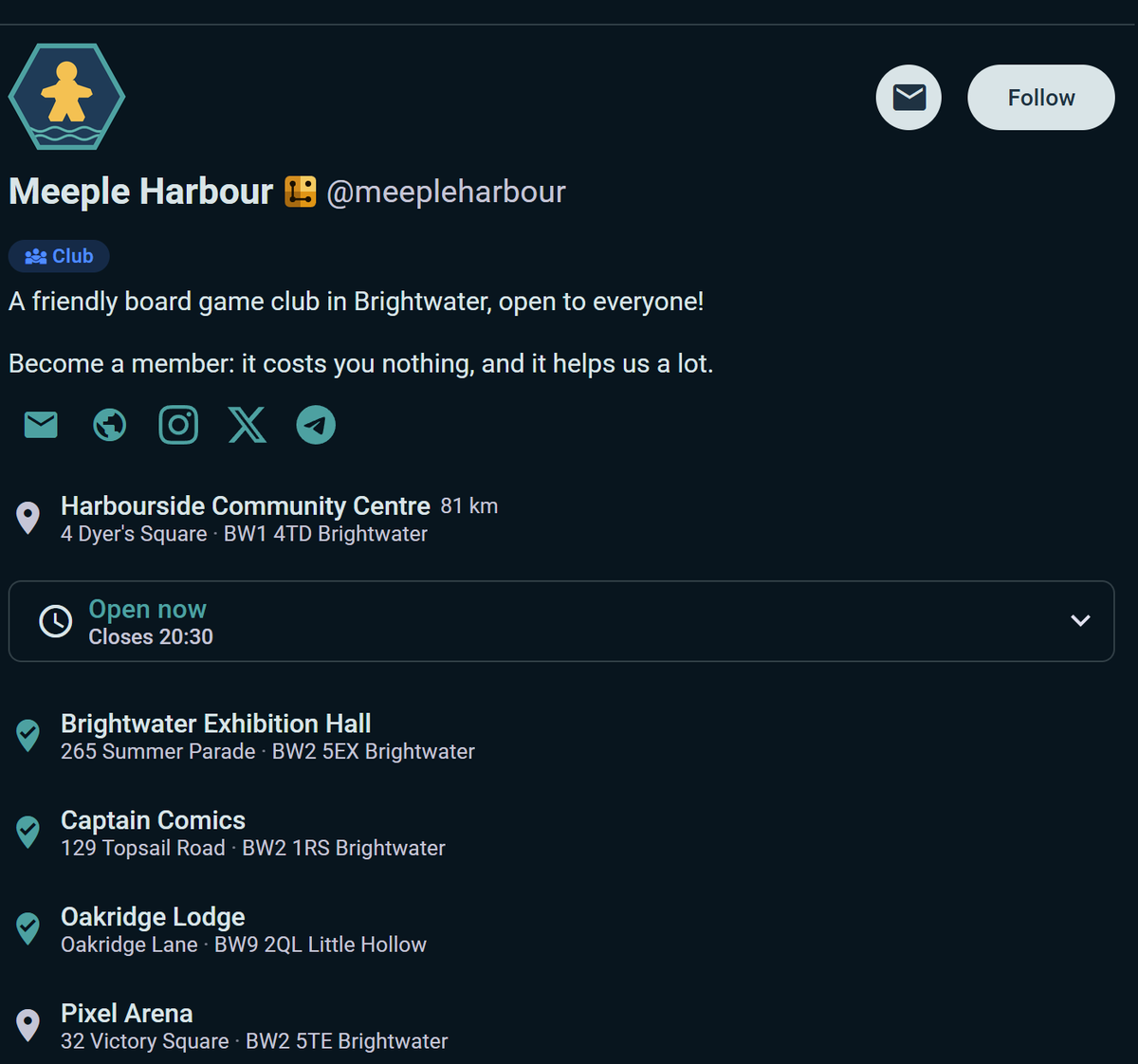
Any account can keep as many locations as it runs — the shop, the hall you rent for conventions, the club's second address — and use them on events, with their own opening hours, spots and floor plan. What this adds is the profile: instead of the main address alone, visitors see every location you run, each with its hours, so they find the right door on the right day.

QR Entry Verification
Stop gate-crashers without running a paper list. Each attendee shows an on-demand QR code from the event's page, and organizers scan it at the door with any phone, tablet or laptop with a camera to instantly confirm the person is on the RSVP list — then one tap on Check in records that they came, party included. Anyone who never turned up can be marked as a no-show afterwards. Great for venues, conventions, and organized play.

Interactive Venue Floor Plans
Upload a floor plan image for your venue and place each spot on it — attendees explore a pannable, zoomable map with every table, room, or play area marked. Sub-events and scheduled games each claim a spot, so everyone always knows exactly which table or room to head to.
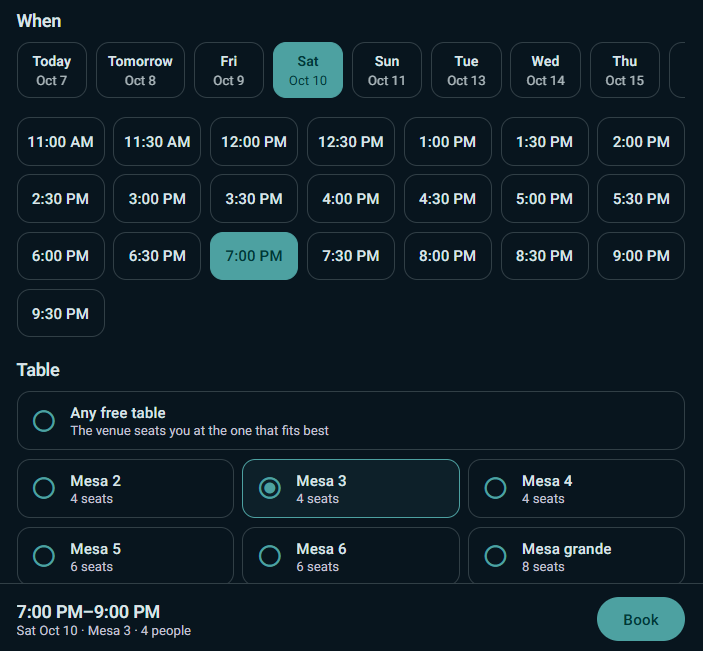
Table Bookings
Put "Book a visit" on your profile. Visitors pick how many they are, how long they stay, the day and a free time; then a table, on your floor plan if you have one, and the games they want waiting for them. They can book without a Ludoya account, and get a link to change or cancel. The times come from your opening hours, a table is never booked twice, and the games you hold for a visit are not offered to anyone else at the same time. Keep some tables for walk-ins, leave a few minutes between visits to clear them, and confirm each booking by hand if you prefer. Your desk shows the whole day, takes phone bookings and walk-ins, and tells you who has not turned up before. The same booking page fits on your own website with one line of code.
Event on the Big Screen
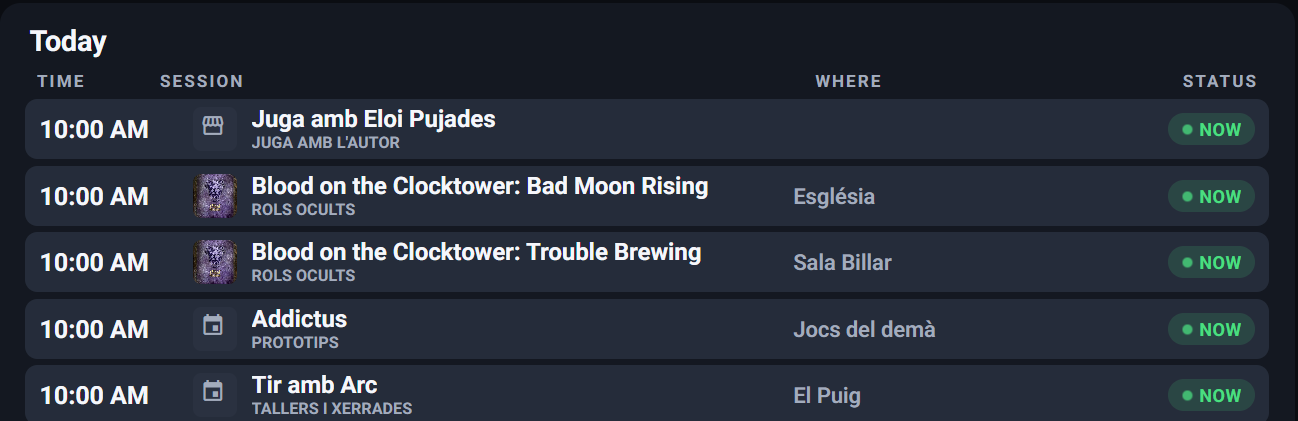
Open any event in full screen on the laptop under the projector, or on a TV. A tournament shows the round being played, table by table, beside the standings, and both update as results come in; players who climb get an arrow, and when it ends a podium takes the round's place. Once it reaches a knockout, the screen draws the bracket itself, losers bracket included, with every result and the match being scored right now. A convention or a club night shows its programme like a departures board, however deep it goes: each session with its section and its room, what is on now, how many seats are left, and the sessions about to start taking turns on a countdown card. The board holds today, the shops, bar and open library get an "All day" list of their own, and long lists turn their pages by themselves, so everything is on the wall at some point. The screen needs nobody signed in, keeps the display awake, says so when it loses the connection, and carries a QR code to follow the event on a phone.
Quiz Trail
Turn your festival into a gimcana. Every stand taking part gets a printed poster with its own QR and one question: pick an answer, type it, or just find the stand. Visitors scan with their phone's camera and play in the browser, with nothing to install: the first stop asks their name and email, every other stop opens straight on its question. You follow the answers and the ranking live, decide whether players see right or wrong at once or at the end, and raffle prizes among those who found the most stops or got the most right, with right answers counting as extra tickets if you like.
Event Game Library
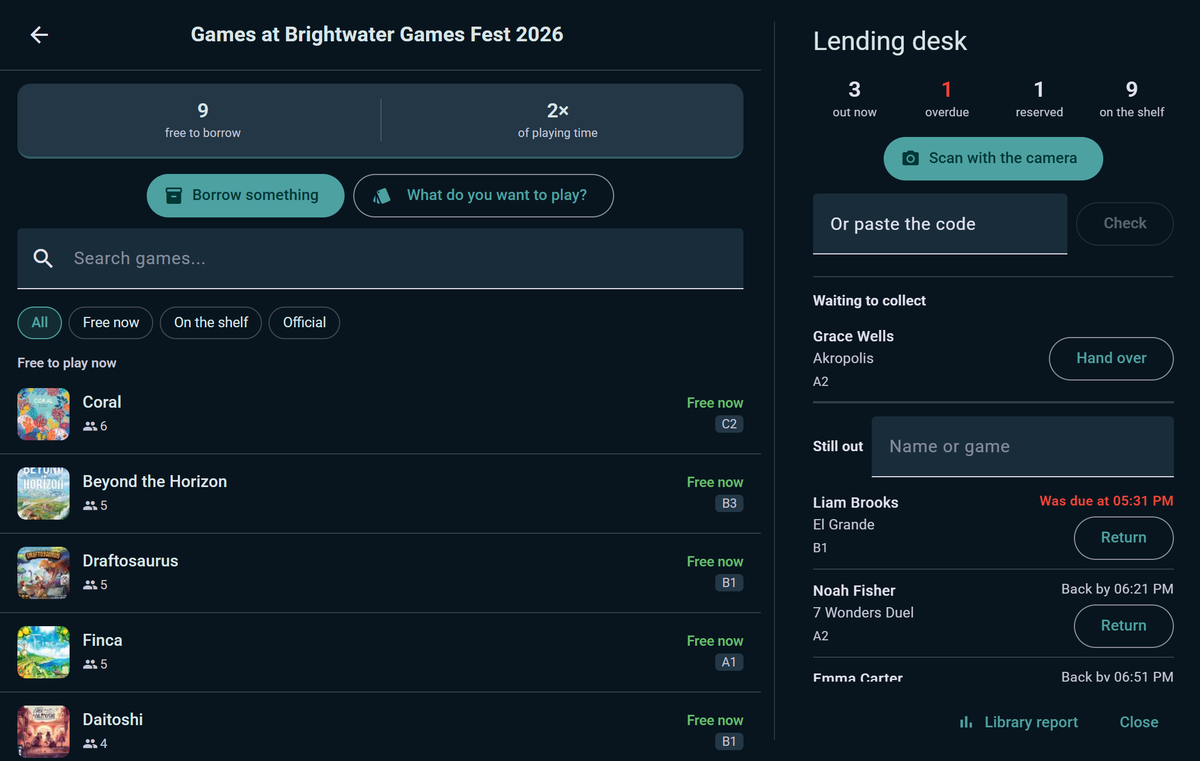
Turn any event into a staffed lending library, with nothing printed and nothing stuck on the boxes. Visitors browse the whole shelf from the floor, see what is free right now and where each box sits, and tap to borrow — a code appears with five minutes on the clock, and it holds the copy so nobody queues for a game that is already gone. Your staff scan that code as the box changes hands, and the loan starts with a return time on it: one length for the whole shelf, or one taken from each game's own playing time. Returning is the same scan in reverse. The desk screen lists reservations waiting to collect and everything that is out, overdue first, and staff can hand a game over or take it back with no scan at all when a phone is dead. Set how many games one visitor may hold, ask the event's questions before a first loan, tell people the moment a title they wanted comes back, and read the report afterwards.
Second-Hand Market at Your Events
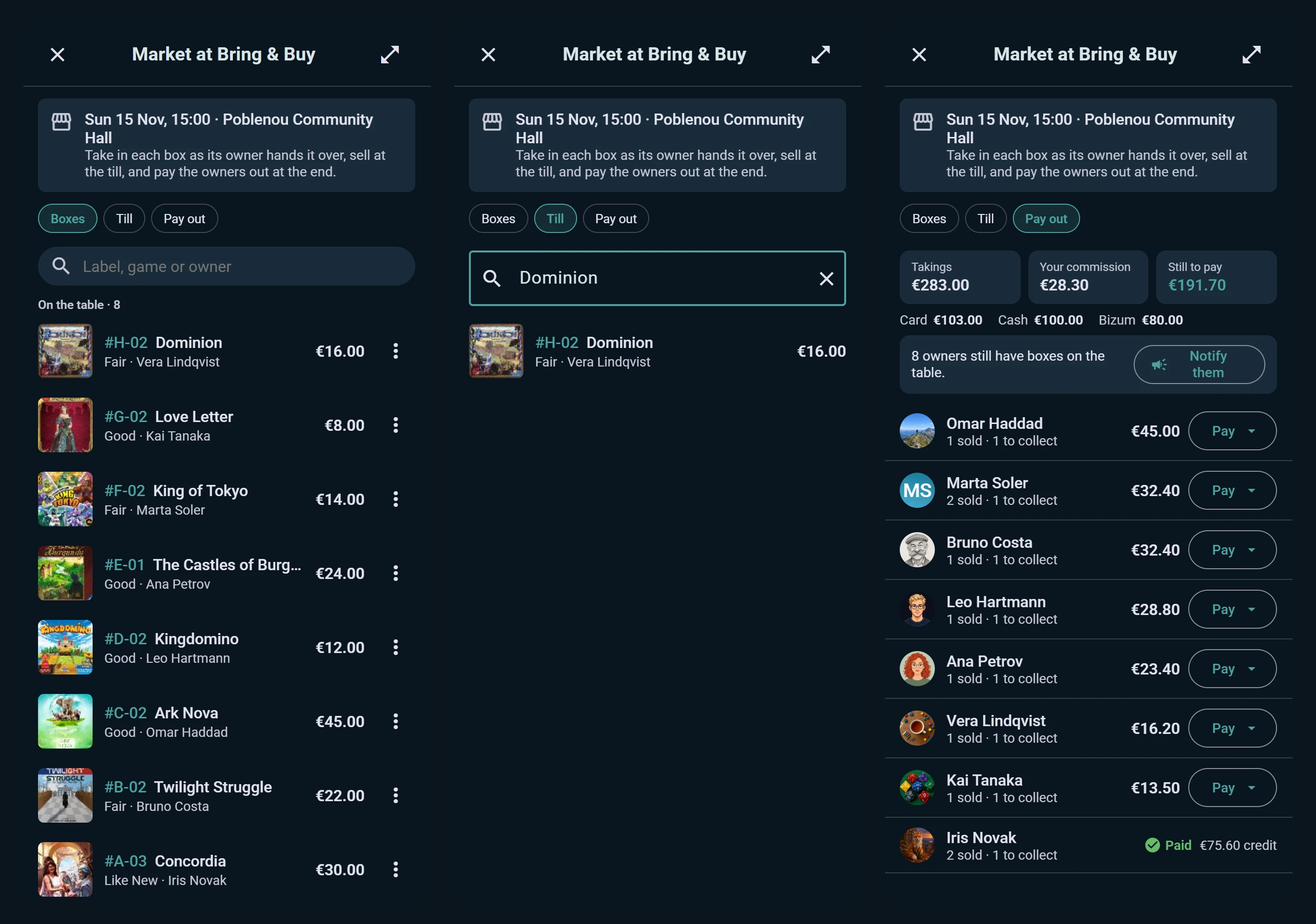
The classic Bring & Buy, without the clipboard. Owners hand their boxes to your table and you take each one in with its owner, condition, price and a label number, so it goes on sale straight away; owners don't need a Ludoya account. Set the market's commission once, or per box. The till finds a box by its number, its name or its owner, and keeps working without signal: sales wait on the device and go through when the connection is back, and a box sold twice is flagged rather than counted twice. At the end, the payout splits the takings by payment method and shows each owner what they sold and what they are owed, in cash or, for a shop, in store credit worth a bonus on top. Owners get a notice when a box sells, and see their own boxes on the event page. Letting attendees sell their own games to each other is free on every plan.
Auto open/close
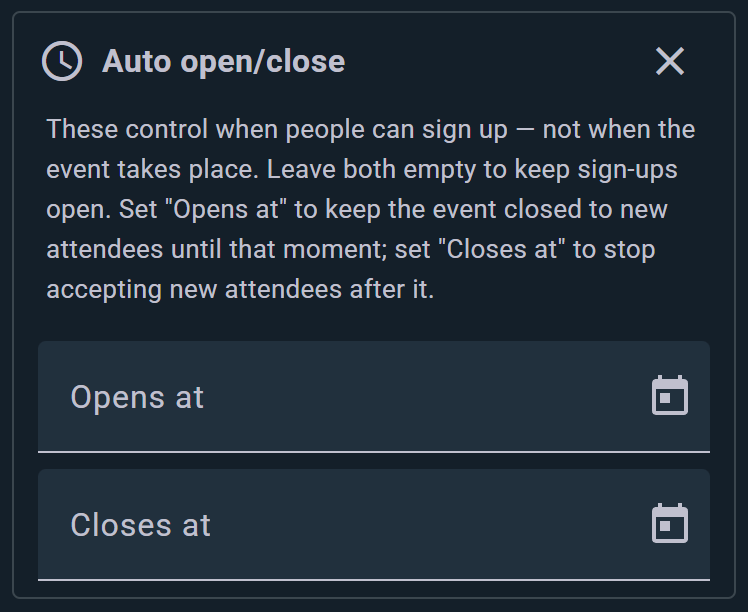
Set a specific date and time for registration to open, and another for it to close — Ludoya handles it automatically. No need to be online at the right moment. Useful for early-bird windows, last-minute cut-offs, or keeping sign-ups locked until you're ready to announce.
Raised API Limits
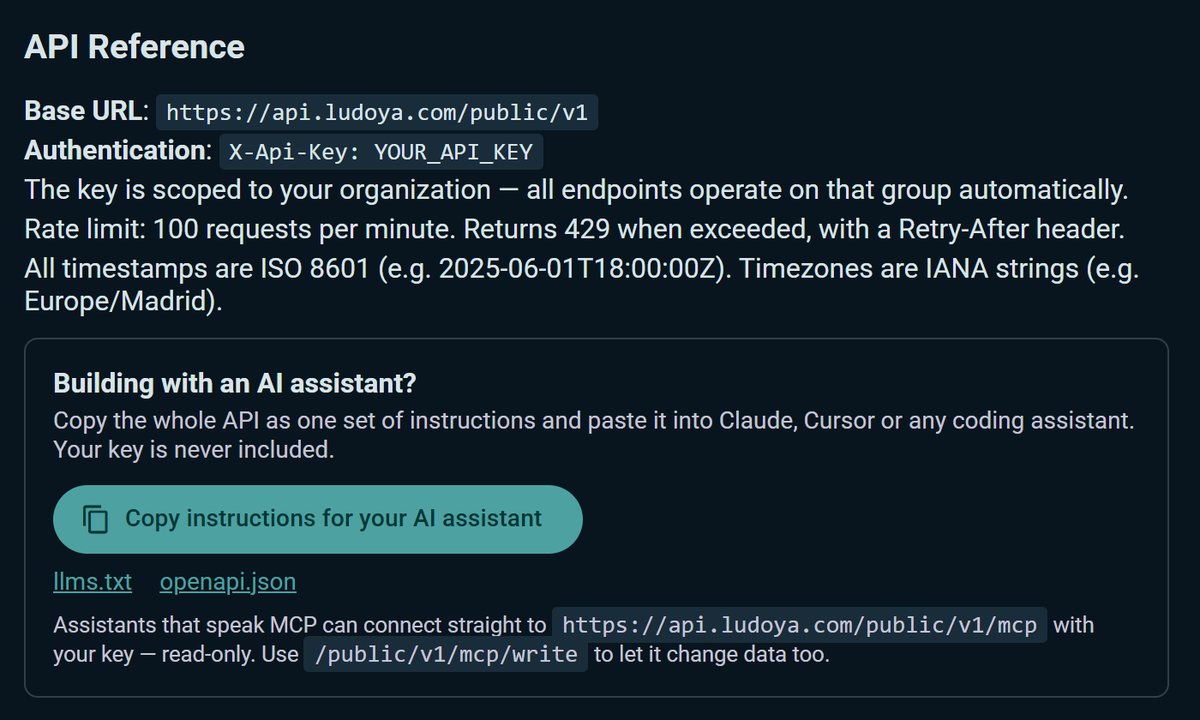
Business lifts the ceiling on the Public API. A Club key allows 30 requests a minute and 2,000 a day — plenty for a website that lists your events. A Business key runs at 100 a minute and has no daily cap at all, which is what a busy storefront, a full convention programme pushed in one go, or an assistant working through your data actually needs. Nothing to configure: the key you already have speeds up the moment the plan does.
Frequently Asked Questions
Ready to level up your game nights?
Join players, clubs, and venues using Ludoya every week.
See the plans